
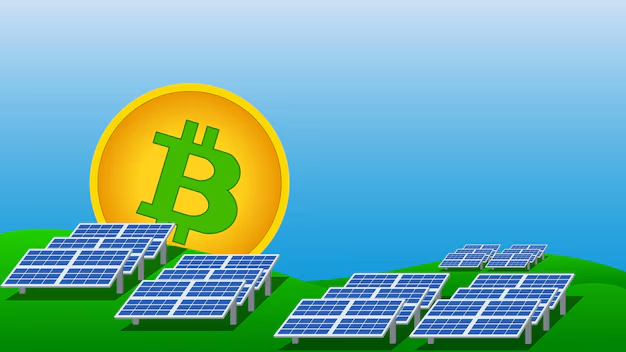
The reason solar powered crypto mining 2026 has become the gold standard is simple: the “Efficiency Ceiling.” In the past, you could always buy a faster miner to stay ahead of the difficulty curve. Today, hardware efficiency has hit a point of diminishing returns. The Bitmain Antminer S21 Ultra and the NVIDIA RTX 5090 are marvels of engineering, but they still eat electricity for breakfast.
In 2026, the only way to significantly increase your margin is to lower your input cost to zero. When you own your power, every satoshi or token you mine is pure profit after the initial hardware payoff. Furthermore, with the expiration of several residential solar tax credits (like the U.S. 25D credit) looming at the end of the year, there has never been a more urgent time to lock in your infrastructure.
The 2026 Hardware Stack: Panels and Rigs
To build a successful solar powered crypto mining 2026 setup, you need to match your generation capacity to your consumption. Gone are the days of “guessing” how many panels you need.
Energy Generation Metrics for 2026: The standard for high-efficiency installations this year is the N-type TOPCon panel. A standard 450-watt TOPCon panel currently operates at approximately 22.5% efficiency, generating roughly 2.2 kWh to 2.8 kWh per day in a region with average sun exposure. If you are running a single Bitmain S21 Ultra, which pulls about 3,500 watts continuously, you would need approximately 28 to 32 of these panels just to cover the daytime load and a portion of the battery charging requirements.
For GPU miners using a rig of six RTX 5090s, the power draw is closer to 2,400 watts. This “smaller” setup is much more manageable for a residential roof, requiring roughly 18 to 22 panels to achieve a carbon-neutral footprint.
Solving the Nighttime Problem: Batteries and Inverters
The biggest hurdle for solar powered crypto mining 2026 is the 12 hours of darkness. Crypto mining is a 24/7 business; if your rigs go dark when the sun goes down, you are losing 50% of your potential revenue and extending your ROI by years.
In 2026, the LiFePO4 (Lithium Iron Phosphate) battery has become the undisputed king of the mining shed. These batteries are safer than traditional lithium-ion and can handle the deep daily discharge cycles that mining requires.
Battery Storage Cost and Capacity Breakdown:
-
Entry-Level (5 kWh): These units, such as the Enphase IQ 5P, cost roughly $5,500 installed. They are best suited for “peak shaving”—running a small GPU rig during the most expensive evening hours.
-
Mid-Range (13.5 kWh): The 2026 iteration of the Tesla Powerwall sits at about $12,500 installed. This is the “sweet spot” for hobbyists, providing enough juice to keep a mid-sized rig running through most of the night.
-
Pro-Scale (30+ kWh): For those running industrial ASICs, modular systems like the Generac PWRcell are required. At a cost of $22,000 or more, these systems offer the redundancy needed to survive 48 hours of cloudy weather without touching the grid.
Pro Tip: In 2026, “Smart Inverters” can now be programmed to automatically throttle your miner’s hashrate based on battery levels. If the clouds roll in, your miner slows down to save the battery for the basic “keep-alive” functions of your home.
The “Digital Rebate” Math: Calculating Your ROI
To understand why solar powered crypto mining 2026 is so attractive, you have to look at the “Opportunity Cost.” If you spend $15,000 on a solar system, you aren’t just buying panels; you are pre-purchasing 25 years of electricity at a fixed rate.
The Comparison: Imagine you pay $0.15 per kWh to your utility company. Running a 1,000-watt rig 24/7 will cost you approximately $1,314 per year. Over ten years, that’s over $13,000 gone forever. If you spend that same $13,000 on a solar setup, you own the asset, your electricity is “free” after year seven, and you have increased the resale value of your home.
In 2026, many miners are also taking advantage of Virtual Power Plants (VPPs). When your batteries are full and your miners are humming, you can “rent” your excess battery capacity back to the grid during heatwaves. This creates a secondary passive income stream that can pay for your internet and hardware maintenance.
Navigating the 2026 Regulatory Landscape
You can’t talk about solar powered crypto mining 2026 without mentioning the tax man. As of January 1, 2026, new reporting requirements (such as DAC8 in the EU) require crypto service providers to report more data than ever before.
However, being a “Solar Miner” gives you a unique legal advantage. In many jurisdictions, the cost of your solar panels and batteries can be depreciated as a business expense if they are primarily used to power a revenue-generating mining operation. This is often referred to as the Section 179 deduction in the US or similar “Green Energy” incentives in Europe. By framing your mining setup as a “Renewable Energy Data Center,” you turn a hobby into a tax-efficient wealth machine.
Step-by-Step: Setting Up Your Solar Mining Hub
Ready to pull the trigger on solar powered crypto mining 2026? Follow this simplified checklist to ensure you don’t burn out your hardware (or your wallet):
-
Conduct a Wattage Audit: Don’t trust the box. Use a Kill-A-Watt meter to measure exactly how much your rig pulls from the wall under full load.
-
Analyze Your “Peak Sun Hours”: A roof in Arizona gets 6 hours of usable sun; a roof in London might get 2.5. Use a solar calculator to find your specific number.
-
Size Your Inverter for the “Surge”: When an ASIC miner starts up, it can spike in power draw. Ensure your inverter is rated for at least 20% more than your continuous load.
-
Ventilation is Non-Negotiable: Solar panels hate heat, and miners produce a lot of it. Never house your batteries and your miners in the same unventilated closet. The heat from the miner will degrade your battery life by half.
-
Automate the Switch: Use a smart transfer switch that pulls from the grid only when the battery hits 20%, ensuring your rigs never lose their connection to the pool.
Conclusion: The Sun Never Sets on the Blockchain
The transition to solar powered crypto mining 2026 is more than just a trend; it is the final form of decentralized finance. True decentralization isn’t just about owning your keys; it’s about owning the very energy that creates the coins.
As the grid becomes more crowded and electricity prices continue to climb, the miners who thrive will be the ones who looked at the sky and saw a battery that never runs out. Whether you are running a single GPU in your bedroom or a full rack in your garage, the sun is ready to hire your roof.