
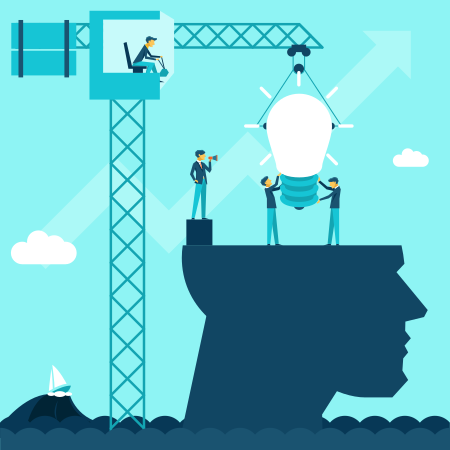
Welcome to 2026, where the “hustle culture” of the early 2020s has finally hit a wall. For years, we were told that the key to success was to be “always on,” to multitask with the speed of a processor, and to measure our worth by the sheer volume of emails sent. But as AI agents have taken over the busywork, a new reality has set in: humans are terrible at being machines, but we are incredible at being craftsmen.
The movement of Slow Productivity 2026 isn’t about being lazy. It’s about the radical idea that high-quality work requires time, focus, and a state of mind we call Cognitive Craftsmanship. In a world where everyone has access to instant AI-generated content, the only thing that remains truly scarce-and therefore truly valuable-is intentional, human-led depth.
The Crisis of Fragmented Attention
Before we can master the art of slow productivity, we have to acknowledge the elephant in the room: our attention is more fragmented than ever. In 2026, the average professional is bombarded by “Neural-Sync” notifications, augmented reality overlays, and a constant stream of real-time data. We have become experts at “shallow work”-answering pings, attending status meetings, and moving digital dust from one corner of the screen to the other.
This constant switching comes with a heavy “Cognitive Load.” Every time you shift from a deep task to a notification, your brain takes an average of 23 minutes to fully regain focus. In a typical eight-hour workday, most people are only truly “present” for about 90 minutes. Slow Productivity 2026 is the antidote to this fragmentation. It is the conscious decision to stop trying to win a race of speed and start winning a race of quality.
Defining Cognitive Craftsmanship
If Slow Productivity is the philosophy, Cognitive Craftsmanship is the practice. Think of a master carpenter from a century ago. They didn’t rush the seasoning of the wood; they didn’t skip the sanding process; and they certainly didn’t try to build ten chairs at the exact same time. They focused on the one piece in front of them until it was perfect.
In 2026, our “wood” is information, and our “tools” are our cognitive faculties. A Cognitive Craftsperson treats their mental energy as a finite, precious resource. They prioritize the “Deep Work” sessions-those three or four hours where the phone is off, the AI assistants are set to “Filter Only,” and the mind is allowed to engage with a complex problem. This is where the breakthroughs happen. This is where you create things that an AI, no matter how advanced, cannot replicate: work with soul, nuance, and original insight.
The Three Pillars of Slow Productivity
To implement a Slow Productivity 2026 strategy, you need to restructure your workflow around three core pillars.
Pillar 1: Do Fewer Things
This sounds counter-intuitive, doesn’t it? But the secret to massive output is radical reduction. When you have twenty projects on your plate, you spend more time managing the projects than doing the work. In 2026, the elite performers are those who say “no” to 90% of opportunities so they can give 100% to the remaining 10%. By narrowing your focus, you allow your brain to build deeper neural pathways related to that specific subject, leading to mastery.
Pillar 2: Work at a Natural Pace
Human creativity does not follow a linear, 9-to-5 schedule. There are “seasons” of high energy and seasons of reflection. Slow productivity encourages you to lean into these cycles. On days when the “flow” is there, you push hard. On days when it isn’t, you step back, read, walk, or engage in “productive procrastination”-activities that seem idle but allow the subconscious mind to solve problems in the background.
Pillar 3: Obsess Over Quality
In an era of infinite content, “good enough” is a death sentence for your career. If a task can be done “good enough” in five minutes, an AI will do it for free. To be valuable in 2026, your work must be exceptional. Slow productivity gives you the permission to spend the extra time needed to refine, polish, and inject your unique perspective into your projects.
Moving Beyond the “Always-On” Culture
Transitioning to a Slow Productivity 2026 mindset requires a “Digital Decoupling.” We have been conditioned to believe that a fast response is a sign of competence. In reality, it’s often a sign of a lack of priorities.
Modern professionals are now setting “Focus Windows” where they are completely unreachable. They are replacing the “instant message” culture with “Asynchronous Communication.” Instead of a back-and-forth Slack thread that lasts all day, they send one comprehensive, thoughtful memo that covers all the bases. This reduces “Collaboration Overhead” and protects the most important asset in the 2026 economy: your undisturbed time.
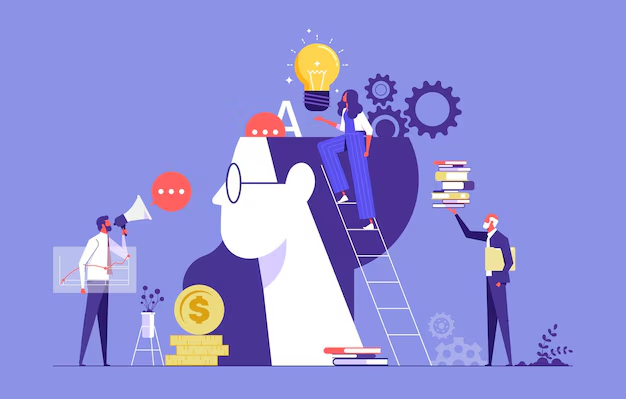
Tools for the Modern Craftsperson
To support your journey into Cognitive Craftsmanship, you need a toolkit that protects your focus rather than stealing it. Here is how the high-performers are setting up their environments this year:
Analog Zones Many of the most successful CEOs and creatives in 2026 have designated “Analog Zones” in their offices-areas with zero screens, where they use physical notebooks and whiteboards. There is something about the tactile act of writing that engages the brain differently than typing, fostering a deeper level of connection to the ideas.
AI Filtering (The Digital Gatekeeper) Instead of letting every notification through, 2026 professionals use “Agentic Filters.” You train your AI assistant to know exactly what constitutes an emergency. Everything else is batched and delivered to you once or twice a day. This ensures that you are the one deciding when to engage with the world, rather than the world deciding when to interrupt you.
Performance Metrics: Impact over Activity The metrics of success have changed. We no longer look at “Hours Logged.” Instead, we look at “Impact Units.” One deep, well-researched article that moves the needle for a client is worth more than fifty generic social media posts. The modern craftsperson tracks how many “Deep Work” hours they achieved in a week, knowing that those are the hours that actually build their legacy.
Final Thoughts on the Slow Revolution
The shift toward Slow Productivity 2026 is ultimately a return to our human roots. We are not designed to be cogs in a high-speed digital machine; we are designed to be thinkers, creators, and problem-solvers. By embracing Cognitive Craftsmanship, you aren’t just improving your work; you are improving your life. You are reclaiming your time, reducing your stress, and ensuring that in a world of automated noise, your voice remains distinct and valuable.
The future belongs to the slow. It belongs to those who have the courage to step off the treadmill and the discipline to do one thing exceptionally well.