
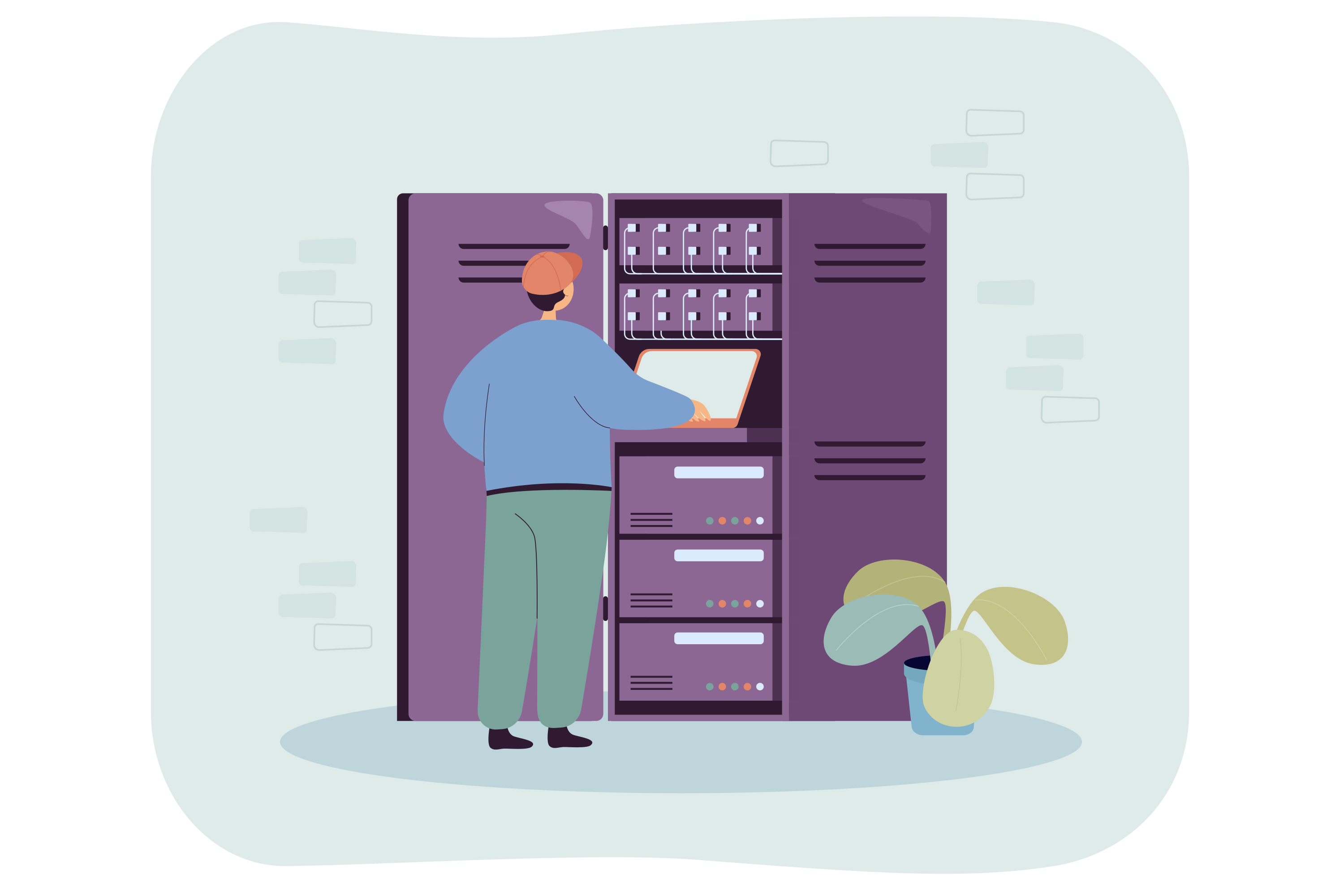
Welcome to the era of the “Home Data Center.” In 2026, the image of a crypto miner as a basement dweller surrounded by loud, heat-spewing boxes is officially a relic of the past. Today, the most successful digital entrepreneurs have transformed their homes into sleek, silent, and sustainable infrastructure hubs. We have moved from a model of “extractive” mining—where you simply take from the grid—to a “contributive” model, where your hardware provides essential services like AI training, decentralized mapping, and local network coverage.
If you want to build a resilient income stream this year, you need a strategy that balances energy efficiency with hardware diversification. This 800-plus-word guide will walk you through the new reality of the 2026 digital economy.
The Three Pillars of the 2026 Digital Economy
To maximize your revenue in 2026, you cannot rely on a single asset. The “Triple-Threat” strategy involves spreading your capital across three distinct but overlapping sectors:
1. High-Performance AI Compute
With the explosion of Agentic AI in 2026, the world has an insatiable hunger for “Inference” power. Your high-end gaming GPUs are no longer just for playing the latest VR titles; they are high-margin assets that can be leased to researchers and developers through decentralized marketplaces.
2. Specialized DePIN Nodes
Decentralized Physical Infrastructure Networks (DePIN) reward you for providing real-world utility. This might mean installing a centimeter-level GPS antenna on your roof for the Geodnet network or sharing your unused fiber bandwidth via protocols like Grass. These devices are low-power, high-uptime, and provide a “baseline” income that remains steady regardless of Bitcoin’s price volatility.
3. Sustainable Proof-of-Work (PoW)
Traditional Bitcoin mining still has its place, but only if it is Sustainable. In 2026, this means utilizing the latest 3nm ASIC chips and integrating them with renewable energy sources like residential solar or wind.
Hardware of the Future: The GPU vs. ASIC ROI
In previous years, we relied on simple tables to compare hardware, but the 2026 market moves too fast for static grids. Let’s look at the “Efficiency-First” hardware breakdown in narrative form.
The current “Gold Standard” for AI compute is the NVIDIA RTX 5090. While it carries a hefty price tag—often between $4,000 and $5,000 in today’s market—its ROI is driven by the rental market rather than mining rewards. On platforms like Vast.ai or RunPod, a high-uptime RTX 5090 can fetch between $0.37 and $0.75 per hour. This means a single card can gross between $270 and $540 per month. When you factor in the power draw of approximately 575 watts, the profit-per-watt remains the highest in the consumer sector.
On the ASIC side, the metric that matters most is $J/TH$ (Joules per Terahash). Next-gen machines like the Antminer S23 have pushed the frontier down to a staggering 11 J/TH. To put that in perspective, a setup pulling 3,500 watts can now produce over 315 TH/s. If you are running legacy gear that operates at 30 J/TH or higher, you are likely mining at a loss unless your electricity cost is below $0.04 per kWh.
The Solar Autarky Model: Off-Grid and On-Point
Sustainability isn’t just an “eco-friendly” badge; it’s a shield against energy price spikes. The Solar Autarky Model is the most popular strategy for the 2026 home operator.
A typical high-yield setup involves a 6 kW solar array paired with a 15 kWh lithium-iron-phosphate (LiFePO4) battery system. This setup, which costs roughly $9,000 to $11,000 after current federal rebates, can power a single high-efficiency ASIC miner and a small GPU rack almost entirely for free during daylight hours.
The math works like this: If your system produces enough excess energy to cover your mining for 8 hours a day, you are effectively cutting your “fuel” cost by 33%. In a market where margins are thin, that 33% reduction often represents the entire difference between a 24-month ROI and an 11-month ROI. Furthermore, the ability to switch your machines to “low-power mode” during the evening—or shut them off entirely when the battery hits a certain threshold—ensures you never pay “Peak” grid prices.
Turning Waste into Wealth: Thermal ROI
In 2026, we no longer talk about “cooling” our miners; we talk about “harvesting” them. Liquid immersion cooling has moved from industrial data centers into the home. By submerging your ASICs in a specialized dielectric fluid, you can capture 95% of the heat they produce.
Smart home integration now allows you to pipe that heat into your domestic hot water tank or your home’s radiant floor heating system. Imagine this: the same electricity that earns you Bitcoin or AI rental fees is also heating your shower and keeping your living room at 22°C during the winter. When you subtract the money you saved on your heating bill from the money you spent on mining electricity, your net profit spikes. This is what we call “Thermal ROI,” and it is the secret weapon of the sustainable miner.
The DePIN Stack: Low Energy, High Utility
While the “Big Rigs” do the heavy lifting, the 2026 home data center is rounded out by a “DePIN Stack.” These are the silent earners.
-
Geodnet & 4DSKY: These devices use very little power (often under 10 watts) and provide geospatial data. Because they require a clear view of the sky rather than a massive power outlet, they are the perfect “peripheral” earners.
-
Helium 5G & Mobile: Providing local connectivity is still highly profitable in high-traffic urban areas. By acting as a “mini-cell tower,” you earn rewards for every gigabyte of data that passes through your node.
-
Grass & Nodepay: These “bandwidth-sharing” protocols allow you to monetize the idle upload speed of your fiber connection. Since you’re already paying for the internet, this is nearly 100% pure profit.
Automation and the “Digital Twin”
Finally, managing a complex home data center in 2026 is no longer a manual task. We now use AI-driven automation and Digital Twins. Most modern mining OS packages include a digital twin of your setup that predicts when a fan might fail or when a chip is underperforming based on thermal patterns.
Automated “Demand Response” software also communicates with your local utility grid. If the grid is under stress, your system can automatically “curtail” (shut down) your miners in exchange for credits from the power company. You get paid not to mine during high-traffic hours, which is often more profitable than the mining itself.
Conclusion: Your Path to Sovereignty
The 2026 home data center is a marvel of efficiency. By combining AI compute leasing, high-efficiency ASICs, and low-power DePIN nodes, you create a diversified income stream that is resilient to any single market crash. When you add solar power and heat reclamation to the mix, you aren’t just a participant in the digital economy—you are a foundational part of the world’s infrastructure.
Sustainable mining isn’t just the “right” thing to do for the planet; it is the only way to stay profitable in the high-difficulty landscape of 2026