
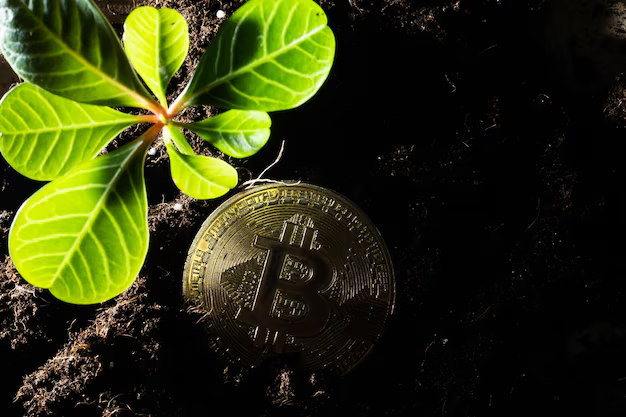
The mining industry in 2026 is defined by a “flight to efficiency.” With the Bitcoin network difficulty hovering near 150T to 160T and the block reward fixed at 3.125 BTC, the margin for error has vanished. In this environment, Sustainable Crypto Mining 2026 isn’t just a buzzword; it is a survival requirement.
Bitcoin has cemented its identity as “Digital Gold,” with prices fluctuating between $80,000 and $120,000. While these prices are attractive, the cost of extracting that gold has risen. The average electricity cost in the United States has climbed to approximately $0.13 per kWh for commercial users, meaning those relying solely on the aging power grid are often mining at a loss. The winners this year are the “Energy Arbitrageurs”—miners who use solar, wind, or “behind-the-meter” hydro power to lower their input costs to virtually zero.
The AI Compute Pivot: Beyond Proof-of-Work
Perhaps the biggest shift in Sustainable Crypto Mining 2026 is the emergence of GPU-based AI compute leasing. If you own a fleet of high-end graphics cards, you are no longer limited to mining altcoins like Ravencoin or Ethereum Classic.
Platforms like Akash Network, Bittensor, and Argentum AI have created liquid marketplaces where you can rent your GPUs to AI startups. For a miner equipped with NVIDIA RTX 5090s, the revenue from rendering or model training is often 3x to 5x higher than traditional mining. This “hybrid” approach—using ASICs for Bitcoin and GPUs for AI—has become the gold standard for residential and small-scale operations in 2026.
2026 Hardware Spotlight: Leading the Efficiency Race
In 2026, your hardware’s efficiency ratio (measured in Joules per Terahash, or J/TH) is the single most important metric in your dashboard. If your machines are operating at anything above 25 J/TH, you are likely burning your profits in heat waste.
The ASIC Heavyweights
The current market leaders for Bitcoin mining are the Bitmain Antminer S21e XP Hydro and the Bitdeer SealMiner A2 Pro. These machines are engineering marvels. The S21 XP Hydro delivers a staggering 860 TH/s while maintaining an efficiency of roughly 13 J/TH.
However, these high-end units require specialized infrastructure. Hydro-cooling systems have become common for home miners this year because they eliminate the deafening noise of traditional fans and allow the heat to be repurposed—many miners are now using their rigs to heat home swimming pools or domestic water tanks, creating a secondary “thermal ROI.”
GPU and AI Hardware
For those focused on Sustainable Crypto Mining 2026 via altcoins or AI, the RTX 5090 is the undisputed king. With its massive VRAM and dedicated AI cores, it is the only consumer card that can effectively handle the inference workloads demanded by decentralized AI subnets. Even when mining ASIC-resistant coins like Monero (XMR) or Ravencoin (RVN), the 5090’s efficiency ensures that more of your rewards stay in your wallet rather than going to the utility company.
Powering the Future: Solar and “Digital Rebates”
The true secret to Sustainable Crypto Mining 2026 is disconnecting from the volatile energy market. Solar-powered mining has moved from a niche hobby to a mainstream financial strategy. By pairing high-efficiency N-type TOPCon solar panels with LiFePO4 battery storage, miners are achieving what we call the “Digital Rebate.”
How the Digital Rebate Works
In many regions, utility companies offer “Demand Response” programs. In 2026, smart mining software can automatically shut down your rigs during periods of high grid stress and sell your stored battery power back to the utility at a massive premium.
Essentially, your mining rig acts as a “buffer.” When the sun is shining and power is abundant, you mine Bitcoin or provide AI compute. When the grid is struggling, you stop mining and become a power provider. This dual-revenue stream can shorten the payback period for a solar installation from seven years to less than four.
Profitability Analysis: Breaking Down the Numbers
To understand the financial viability of Sustainable Crypto Mining 2026, we must look at the “Net Daily Margin” across different energy tiers. In the 2026 market, your success is almost entirely a function of your electricity rate.
For miners with access to Ultra-Low Cost Energy ($0.03 – $0.04 per kWh)—typically those with their own solar arrays or based in regions like Ethiopia or parts of Scandinavia—the profit potential is very high. A top-tier miner like the Bitdeer SealMiner A2 can net between $20 and $25 per day after expenses.
For those in the Moderate Cost Tier ($0.06 – $0.08 per kWh), the game becomes more competitive. Profitability is still achievable, but it requires the absolute latest hardware. An Antminer S21 Pro might net $12 to $15 per day, meaning the “Time to ROI” for the hardware is roughly 12 to 14 months.
Finally, for the Standard Grid Tier ($0.12 – $0.15 per kWh), traditional Bitcoin mining is largely a break-even endeavor. However, these users can still thrive by pivoting to DePIN (Decentralized Physical Infrastructure Networks). Projects like Grass or Helium allow users to earn rewards by sharing bandwidth or providing sensor data with almost zero electricity draw, making them the perfect entry point for urban dwellers.

Diversification: The Rise of DePIN and Merged Mining
One of the most overlooked aspects of Sustainable Crypto Mining 2026 is the concept of “Stacked Rewards.”
Merged Mining allows you to mine multiple coins simultaneously using the same energy. The most popular pairing in 2026 remains Litecoin (LTC) and Dogecoin (DOGE). By using a Scrypt-based ASIC like the ElphaPex DG2+, you receive both LTC and DOGE rewards without increasing your power consumption by a single watt.
Furthermore, DePIN nodes have become a vital part of the home mining kit. These small, low-power devices act as decentralized cloud storage (Filecoin) or weather stations (WeatherXM). While a single node might only earn $30 to $50 per month, a diversified “rack” of DePIN devices can easily cover the internet and maintenance costs of a larger Bitcoin operation.
Conclusion: Becoming a 2026 Infrastructure Provider
The era of the “crypto miner” is evolving into the era of the “decentralized infrastructure provider.” To succeed in Sustainable Crypto Mining 2026, you must view your setup not just as a way to generate coins, but as a multipurpose data center.
By integrating renewable energy, staying ahead of the efficiency curve, and diversifying into AI compute and DePIN, you can build a resilient, profitable business that thrives regardless of market volatility. The sun is shining, the blockchain is growing, and the rewards are waiting for those who mine smart.