
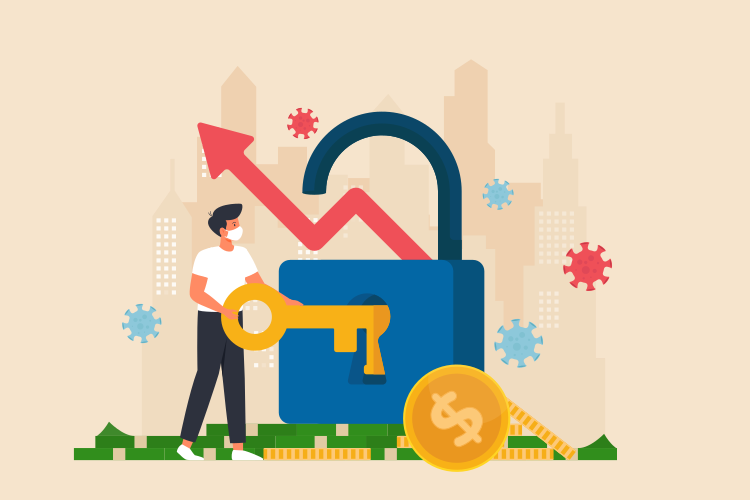
Security for a miner is different than security for a casual investor. While an investor only needs to worry about their wallet, a miner has multiple “points of failure”: the mining rig, the mining pool account, and the payout address.
To build a “Fortress Rig,” you need to address all three levels of the stack.
1. Hardening the Pool Account (The First Line of Defense)
Most miners use a pool to get steady payouts. Your pool account is essentially a “holding tank” for your earned crypto before it reaches your wallet.
-
2FA is Mandatory: Never use SMS-based two-factor authentication. In 2026, SIM-swapping is a common attack. Use a dedicated authenticator app like Authy or a physical security key like a YubiKey.
-
Payout Whitelisting: Most reputable pools (like 2Miners or Hiveon) allow you to “whitelist” a payout address. This means that even if a hacker gains access to your account, they cannot change the destination of your coins without a 48-hour waiting period and multiple email confirmations.
-
Auto-Payout Thresholds: Don’t let large amounts of crypto sit in your pool account. Set your auto-payout threshold as low as is reasonably possible given the network fees. Treat the pool like a temporary transit station, not a bank.
2. Defending Against Hashrate Hijacking
A rising threat in 2026 is Hashrate Hijacking. Unlike traditional “Cryptojacking” (where a hacker uses their own code to mine on your PC), a hijacker leaves your mining software running but silently changes the Wallet Address in your configuration file.
You might see your rig running at 100% capacity, but the coins are being sent to the hacker’s wallet instead of yours.
-
Monitor Your Pool Stats: Don’t just look at your rig; look at your pool’s dashboard. If your rig shows it’s “online” but the pool shows $0\text{ MH/s}$, someone has likely hijacked your hashrate.
-
Lock Down Your OS: If you are mining on Windows, ensure “Remote Desktop” is disabled unless you are using a secure VPN. Use a specialized mining OS whenever possible, as these are “stripped down” and have a much smaller attack surface than a general-purpose operating system.
A secure rig is a stable rig. If your hashrate suddenly drops or your configuration changes, it could be a sign of a breach. Check out our guide on optimizing your mining OS settings to learn how to lock down your configuration files against unauthorized changes.
Cold Storage: The Final Destination
Once your rewards leave the pool, they should go directly to a wallet that you—and only you—control. For miners, the choice is simple: Cold Storage.
A “Hot Wallet” (an app on your phone or a browser extension) is always connected to the internet. If your device is compromised, your coins are gone. A Hardware Wallet (Cold Storage) keeps your private keys entirely offline.
The Best Hardware Wallets for Miners in 2026
-
Ledger Nano S Plus: The gold standard for value. It supports thousands of coins and is perfect for miners who want to “set and forget” their payouts.
-
Trezor Model T: Excellent for those who prefer open-source security. Its large touchscreen makes it easy to verify addresses before sending funds to an exchange.
-
Blockstream Jade: A specialized, highly secure option for Bitcoin-only miners, featuring “Air-Gapped” communication via QR codes so the device never even touches a USB port.
The Strategy: Set your mining pool to pay out directly to your hardware wallet address. You can view your balance anytime using the wallet’s companion app, but you only need to plug in the physical device when you are ready to sell or move your funds.
Illustration of money savings protection plan
The “Golden Rule” of Seed Phrases
Your hardware wallet will give you a 12 or 24-word “Seed Phrase.” This phrase is the master key to your money.
-
Never type it into a computer or take a photo of it.
-
Never store it in the cloud (Google Drive, iCloud, etc.).
-
Always write it on paper or stamp it into a steel plate and store it in a fireproof safe.
Managing multiple rigs and wallets can get complex. If you are scaling up your operation, read our guide on how to remotely manage a mining rig to learn how to monitor your payout addresses and rig status from a single, secure encrypted dashboard.
Pro Tip: The “Exchange Pass-Through”
Some miners prefer to have their coins sent directly to an exchange like Coinbase or Binance so they can sell them immediately for cash to pay for electricity. While convenient, this is risky. Exchanges are targets for hackers and “account freezes.”
The Secure Method:
-
Mine to your Hardware Wallet.
-
Once a month, move the specific amount you need to cover your electricity bill to the Exchange.
-
Keep the “profit” (your long-term savings) in your hardware wallet.
Conclusion: Your Security is Your Profitability
In the mining world, a “hack” is just another expense—one that can easily wipe out a year of hard-earned gains. By implementing 2FA, whitelisting your addresses, and using cold storage for your final payouts, you ensure that the coins you work so hard to mine actually stay in your pocket.
Don’t let your mining rig work for a stranger. Secure your rewards, protect your keys, and treat your mining operation with the same security discipline as a professional data center.